DOSH Haze Guidelines 2026: What Employers Must Do at Each API Level
DOSH has issued a second edition of its workplace haze guidelines. The measures are the same as in 2013. The penalty figures it quotes are ten times higher.
Checked against official sources (DOSH, DOE) on
New to DOSH compliance? Start with the 10 things Johor factory owners need to know.
Live: today’s API for Johor Bahru and all 8 Johor stations →
Free download: haze action poster (A4 PDF), worker phone poster and N95 how-to-wear poster, in English, Bahasa Malaysia and Chinese →
The Department of Occupational Safety and Health (DOSH / JKKP) has published the Guidelines for the Protection of Employees Against the Effects of Haze at Workplaces, 2nd Edition (2026). It replaces the 2013 edition and tells employers what to do as the 24-hour Air Pollutant Index (API) rises.
The guideline itself is not law, but the duty behind it is. That duty sits in section 15 of the Occupational Safety and Health Act 1994: employers must provide a work environment that is safe and without risk to health. Breaching it carries a fine of up to RM500,000, up to 2 years’ imprisonment, or both. The guideline describes what meeting that duty looks like during haze. Where haze poses immediate danger and the risk has not been controlled, DOSH can order the affected work to stop.
API above 100 = unhealthy air. Employers must assess the risk and put suitable controls in place.
Symptoms to watch for
- Cough / itchy throat
- Sore, watery eyes
- Runny nose / sneezing
- Itchy skin
- Difficulty breathing
Prepare the workplace early
- Identify susceptible staff
- List outdoor work to reduce
- Set stop-work criteria
- Stock N95 respirators
- Improve air cleaning
- Set up haze updates for staff
What changed from the 2013 edition
- Penalty figures raised to match the amended Act. Failing to comply with a stop-work order now carries a fine of up to RM500,000, up to 2 years’ imprisonment or both, plus RM2,000 for each day the offence continues. The 2013 edition quoted RM50,000, 5 years and RM500 a day. A breach of the section 15 duty is now quoted at up to RM500,000 (previously RM50,000) or 2 years.
- Updated air quality reference. API values are now tied to the Malaysian Ambient Air Quality Standard (MAAQS) issued by the Department of Environment (DOE), replacing the older Malaysian Air Quality Guidelines.
- Risk assessment reference. The 2013 edition pointed to the HIRARC guideline. The 2026 edition refers generally to DOSH’s guidelines on risk management.
- No change to the API bands, the measures at each band, or the respirator requirements.
If your haze procedure was written against the 2013 edition, the measures still hold. Update the penalty figures and references.
Before the haze arrives
Once a government agency announces an increased risk of haze, the guideline expects employers to:
- identify susceptible employees, meaning those with heart or respiratory illness;
- identify employees with haze-related symptoms and ask them to seek medical treatment. Symptoms include throat itchiness, coughing, watery eyes, a running nose, itchy skin and difficulty breathing;
- list the outdoor work to be reduced when there is haze, and set the criteria for stopping it;
- fit-test respirators for employees who need to work outdoors;
- keep enough stock of disposable N95 respirators;
- improve the efficiency of air cleaning devices for the workplace and equipment;
- set up a haze communication system between employer and employees.
What to do at each API level
The guideline sets out what the employer and employees do as the 24-hour API rises.
| 24-hour API | What the employer does | What employees do |
|---|---|---|
| 51–100ModerateFew or no ill effects |
|
|
| 101–200UnhealthySymptoms in susceptible people |
|
|
| 201–300Very UnhealthyWidespread symptoms |
|
|
| 301–400HazardousHealthy people affected |
|
|
| 400+Very HazardousMay be life-threatening |
|
|
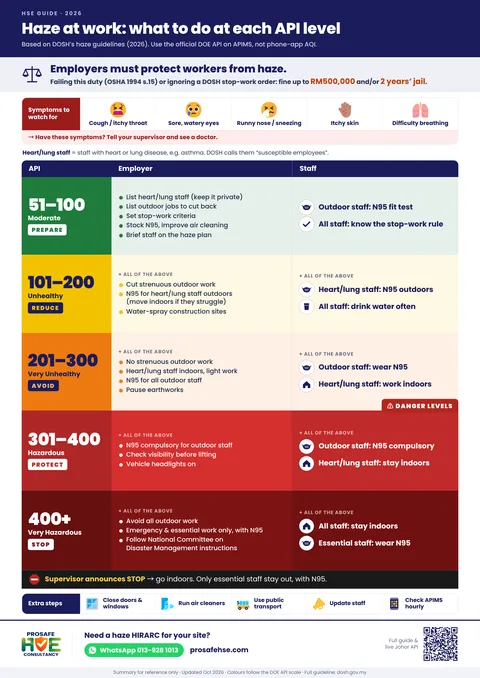
Download the haze action poster (A4)
Everything on this page on one A4 sheet. Print it for the notice board or share it on WhatsApp. Free, no sign-up.
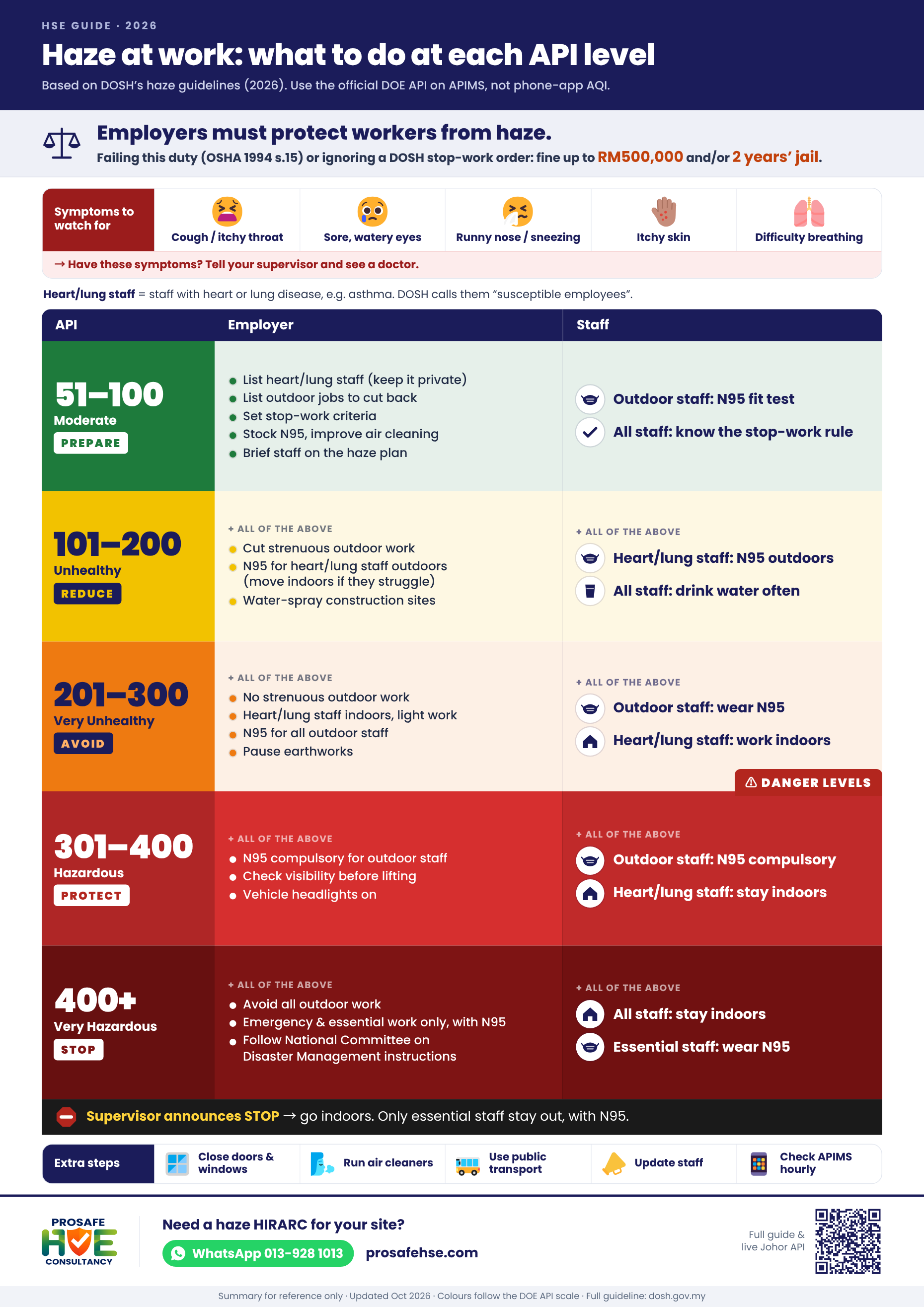
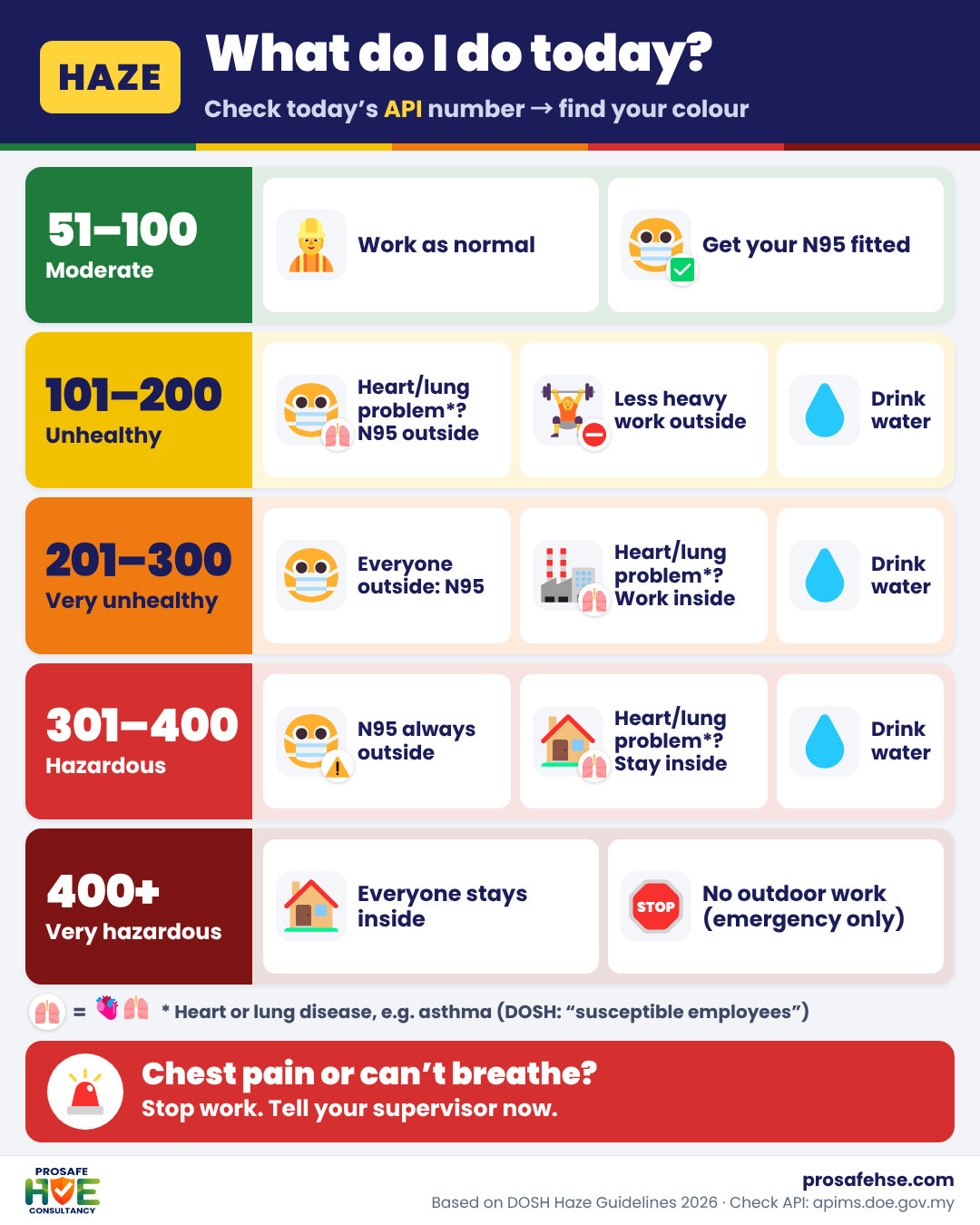
Download: haze worker poster (phone size)
One colour per API level, with picture actions. Made for workers’ phones: share it in your WhatsApp group. Free, no sign-up.
Respirators
Employers must provide suitable respirators when the guideline calls for them. The correct type filters out about 95% of very fine particles. Disposable N95 respirators are preferred because they are more comfortable than cartridge respirators. Wearers need fit testing, training and supervision. Replace a respirator when it is soiled or damaged, or when breathing through it becomes hard.
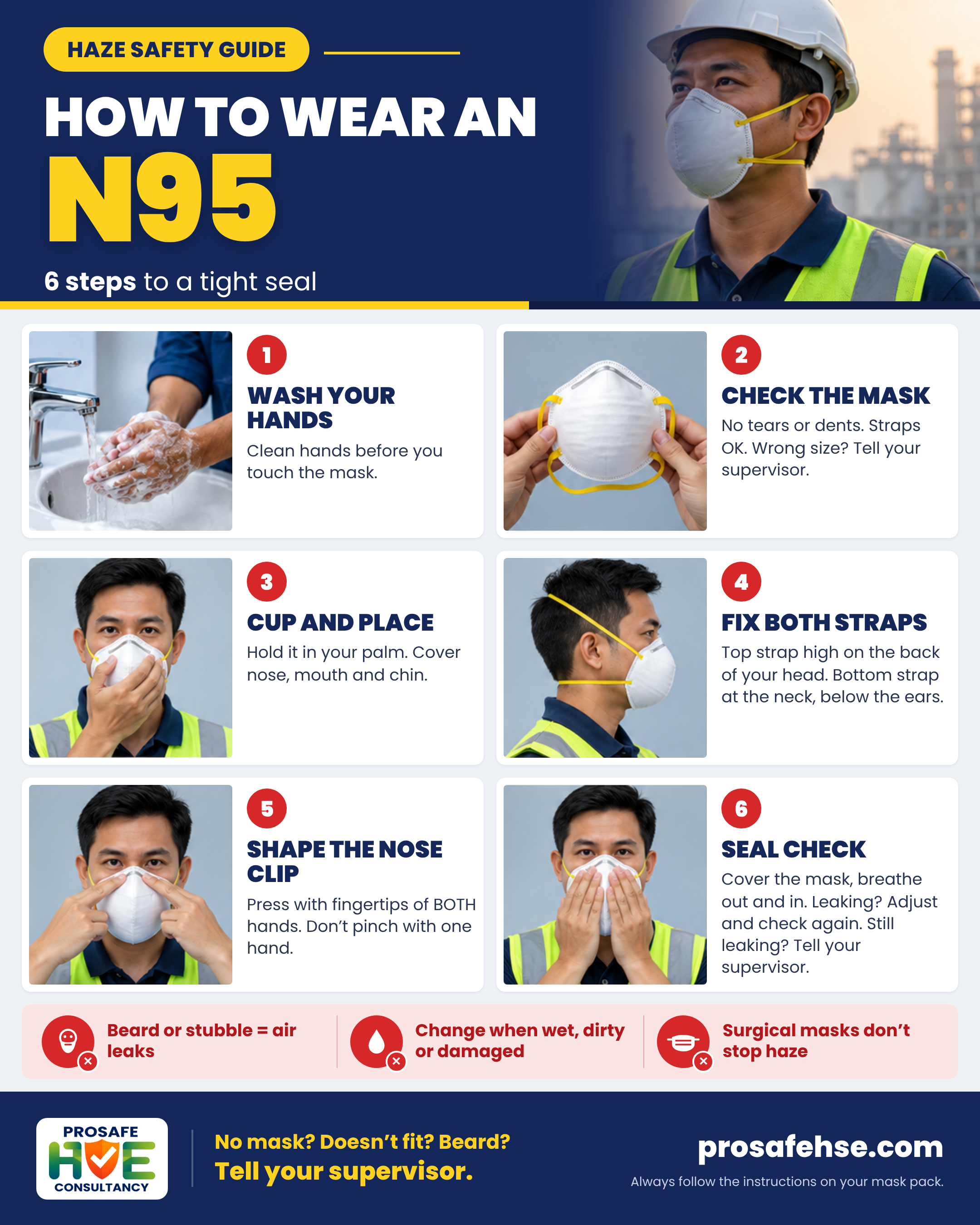
Download: How to wear an N95 (worker poster)
Six photo steps, sized for phones. Share it in your workers’ WhatsApp group or print it for the PPE station. Free, no sign-up.
Indoor work and equipment
Suitable air cleaning devices improve indoor air in both air-conditioned and non-air-conditioned areas. Keep doors and windows closed as much as possible to reduce haze getting inside. Where equipment has an air processing unit, check that its filtration can keep excess dust out of the system.
Communication
Employees should be updated regularly on what the company is doing about the haze, and there must be a channel for them to report health effects. A WhatsApp group or shift briefing works, as long as reports are recorded and acted on.
Reading the API correctly
The guideline uses the 24-hour API published by the DOE through its APIMS portal and the MyJAS EQMS app. Third-party air quality apps use different scales and are not the official figure, so base work decisions on the DOE reading for your nearest station.
One detail to be aware of: the guideline text still names PM10 as the main pollutant. DOE’s API has included PM2.5 since 2017, and the reading is the highest sub-index of the pollutants measured. During haze, particulate matter usually sets that figure. This does not change what you do, because the guideline’s bands apply to the API value itself. It does mean the reading you act on already accounts for fine particles.
A practical checklist for this haze season
- Write down which outdoor tasks stop or reduce at API 100, 200, 300 and 400, and who decides.
- Name one person to check the DOE reading each morning and at shift change.
- Confirm N95 stock and the date of the last fit test for outdoor workers.
- Add poor visibility to the risk assessment for crane lifts, forklift traffic and yard driving.
- Update your haze procedure with the 2026 penalty figures and references.
The full guideline is free to download from the DOSH website.
Sources
- Guidelines for the Protection of Employees Against the Effects of Haze at Workplaces, 2nd Edition (2026) — Department of Occupational Safety and Health (DOSH)
- Guidelines for the Protection of Employees Against the Effects of Haze at Workplaces (2013 edition) — Department of Occupational Safety and Health (DOSH)
- Occupational Safety and Health Act 1994 (Act 514), reprint as at 1 June 2024 — Department of Occupational Safety and Health (DOSH)
- Air Pollutant Index (API) Calculation — Department of Environment (DOE)
- Air Pollutant Index Management System (APIMS) — Department of Environment (DOE)
Haze questions Malaysian employers ask
Are the DOSH haze guidelines law?
The guideline itself is not law, but the duty behind it is. Section 15 of OSHA 1994 requires every employer to provide a work environment that is safe and without risk to health, and breaching that duty carries a fine of up to RM500,000, up to 2 years’ imprisonment, or both. The guideline is how DOSH expects you to meet that duty during haze, so ignoring it leaves you exposed under the Act. DOSH can also order work to stop where haze poses immediate danger, and failing to obey a stop-work order carries its own penalty.
Our factory works indoors. Does the guideline still apply?
Yes. Most measures target outdoor work, but the guideline also covers indoor protection: keeping doors and windows closed, using suitable air cleaning devices, and protecting the filters of equipment with an air processing unit. Loading bays, yard work, forklift routes and guard posts are outdoor work too.
Who counts as a susceptible employee?
Employees with existing heart or respiratory illness. They must wear respirators for outdoor work once the API exceeds 100, and should be moved to indoor, non-strenuous work once it exceeds 200.
Which API reading should we use?
The 24-hour API published by the DOE through APIMS and the MyJAS EQMS app, for the station nearest your site. Third-party air quality apps use different scales and are not the official figure.
Do employees need respirator fit testing?
Yes. The guideline calls for fit testing of employees who need to work outdoors, together with training and supervision on correct use. A disposable N95 respirator is the preferred type.
Is there a free haze poster for the workplace?
Yes. ProSafe HSE Consultancy offers three free posters based on the DOSH haze guidelines 2026, with no sign-up: an A4 haze action poster (PDF, plus a notice-board version with spaces for your person in charge and phone number), a phone-size worker poster for WhatsApp, and a 6-step N95 how-to-wear poster. Each comes in English, Bahasa Malaysia and Chinese. Download them on this page or at prosafehse.com/assets/prosafe-haze-poster-en.pdf.
Not sure your site is ready for the haze season?
Talk to a ProSafe consultant. We’ll look at your outdoor work, indoor air and risk assessment against the DOSH guideline, and tell you what needs to change.